
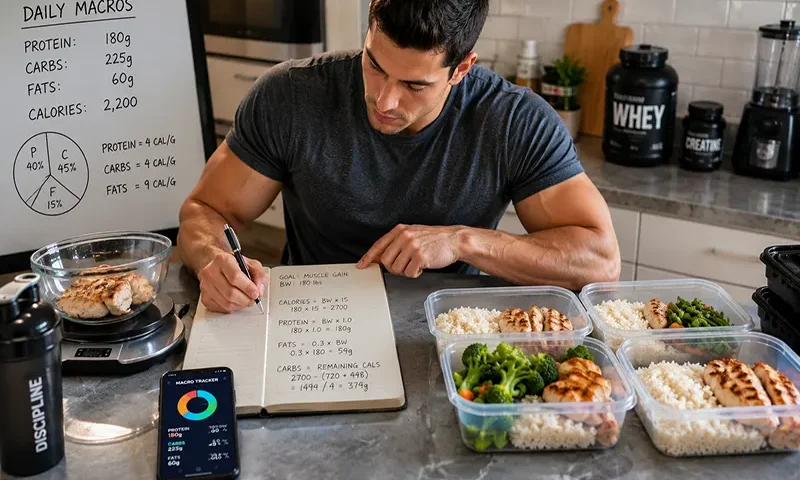
In the world of bodybuilding, nutrition is the most critical variable you control. While general “clean eating” can provide health benefits, it often lacks the precision required to drive specific physiological changes—such as maximal muscle hypertrophy or targeted fat loss. Macro tracking is the process of quantifying your intake of protein, fats, and carbohydrates, effectively turning your nutrition into a measurable data set. By mastering this math, you eliminate the guesswork and ensure that your body has exactly what it needs to perform, recover, and grow.
The Foundation: TDEE and Goal Setting
Before you can track macros, you must determine your Total Daily Energy Expenditure (TDEE)—the total number of calories you burn in a day through basic metabolic functions and physical activity.
To calculate this, use an online TDEE calculator that factors in your age, height, weight, and activity level. Once you have this baseline, you must adjust it to your specific goal:
- For Muscle Gain (Bulking): Add 250–500 calories to your TDEE to fuel growth without excessive fat gain.
- For Fat Loss (Cutting): Subtract 300–500 calories from your TDEE to create a sustainable energy deficit.
- For Body Recomposition: Stay at your TDEE maintenance level, focusing on high-quality nutrient partitioning to gain muscle while slowly losing fat.
The Macro Hierarchy
Not all calories are created equal. Different macronutrients have distinct roles in the body, and your “macro split” should reflect the metabolic needs of a bodybuilder.
- Protein (4 calories per gram): Protein is the driver of Muscle Protein Synthesis (MPS). Regardless of your caloric goal, you must keep protein intake high to maintain a positive nitrogen balance and protect lean tissue. Aim for 1.6g to 2.2g of protein per kilogram of body weight.
- Fats (9 calories per gram): Fats are essential for hormonal health, specifically for the production of testosterone. Do not cut fats too aggressively. Aim for 0.8g to 1.0g of fat per kilogram of body weight as a floor.
- Carbohydrates (4 calories per gram): Carbs are the body’s preferred fuel source for high-intensity training. Once you have accounted for your protein and fat, the remaining calories in your daily budget should be filled by carbohydrates. These are vital for glycogen replenishment, which keeps your muscles looking “full” and fuels your lifting performance.
The Math: A Step-by-Step Example
Let’s look at an 80kg (176lb) athlete with a daily goal of 2,500 calories.
- Step 1: Protein (2g per kg): 80kg × 2g = 160g protein (160 × 4 kcal = 640 kcal).
- Step 2: Fats (1g per kg): 80kg × 1g = 80g fat (80 × 9 kcal = 720 kcal).
- Step 3: Carbohydrates: Remaining calories. 2,500 kcal – (640 + 720) = 1,140 kcal. Divide by 4 = 285g of carbohydrates.
| Macronutrient | Grams per Day | Total Calories |
| Protein | 160g | 640 |
| Fat | 80g | 720 |
| Carbohydrates | 285g | 1,140 |
| Total | 2,500 |
Translating Macros into Meal Prep
Precision in calculation is useless without precision in application. To hit these numbers, you must stop relying on volume measurements like “a cup” or “a scoop,” as these are notoriously inaccurate. Invest in a digital food scale.
- The Base-Meal Method: Instead of prepping elaborate recipes every day, create “base meals” that consist of a single protein source, a starch source, and a fat source. For example, a base meal might be 150g of chicken breast, 200g of cooked rice, and 10g of olive oil.
- Adjusting the Totals: By keeping your base meals consistent, you can easily add or subtract portions to hit your exact macro targets for the day, allowing for flexibility while maintaining strict dietary discipline.
Macro tracking is not a life sentence; it is a tool for self-education. Over time, you will learn exactly what different portions look like, eventually allowing you to maintain your physique with more intuitive habits. Focus on consistency over short-term perfection. If you miss a target by a few grams, don’t panic—the body tracks its intake over the course of the week, not just the day. Stay consistent, measure accurately, and let the data guide your transformation.

